Shipwrecks and Sunsets
What artist can make you question God in one phase of life and serve as the soundtrack for your best college weekends later on?
Gordon Lightfoot.
Lightfoot passed away last week, leaving behind a rich musical legacy—especially for those of us who grew up in the Great Lakes region.
Shipwrecks
If you went to elementary school in Michigan in the 1980s, you weren’t moving on unless you’d memorized Lightfoot’s “The Wreck of the Edmund Fitzgerald.”
It’s not a song. It’s a narrative poem set to haunting music, a six-minute, twenty-nine second harrowing journey with the crew of the freighter swallowed by Lake Superior in one of Michigan’s sneaky-strong November storms.
In the 4th grade we listened to the song over and over. We drew pictures of the freighter. Eventually, the song and the story burned into our memories for good.
The song came out in 1976. But to me and my fellow fourth graders, it might as well have been 1796.
We were living in 1984, and it was the future. Michael Jackson was moonwalking. Van Halen was using a space-age synth sound on its new hard rock album. The government planned to blast missiles out of the sky with satellite weapons. And here was this bearded-hippie looking guy strumming some acoustic guitar and singing about a boat that sank Up North.
Outwardly, we were all annoyed by the song. On the verge of adolence, we were showing early signs of needing to look cool.
Inside, I loved the song.
It’s was frightening and tragic. Plus, there was something surreal about a song retelling an event that happened near me. Eighties pop music was (and is!) great. But the songs all seemed to tell tales from coastlines far to the west or east.
Lightfoot sang about something that happened right off the shoreline in my state. That was mind-blowing.
And there was the way Lightfoot told the story. No passage from the song stuck with me more than this one:
Does any one know where the love of God goes
When the waves turn the minutes to hours?
We’d been taught God loves us and will protect us. And yet, this, and other terrible things, did happen. Why? Later in life I discovered trial and tragedy doesn’t mean God is absent. It fact, he’s often most present in our hardest moments.
But as a 4th grader those lines left me feeling vulnerable. A harsh truth, exposed in a Midwestern Iliad.
Sunsets
The mid-90s were a fantastic time for rock. Pearl Jam was at the peak of its powers. We had Green Day. Smashing Pumpkins. Even Hootie and Blowfish reeled off five hit singles.
And yet, when my friends and I assembled each fall for the Michigan vs. Michigan State football game weekend, it’s was Lightfoot’s “Sundown” that served as the weekend’s central anthem.
I don’t know why. I don’t remember where we first picked it up. It’s certainly not a party tune.
The song is about Lightfoot’s tumultuous relationship with Cathy Smith, the woman who would later deliver the fatal dose of heroin to John Belushi.
The song has a seething anger to it. Lightfoot plots revenge.
Sundown, you better take care
If I find you been creeping 'round my back stairs
And underneath his anger, stoking its fire, is a dull and incessant ache:
Sometimes I think it's a shame
When I get feeling better, when I'm feeling no pain
Not exactly “Everybody Have Fun Tonight.”
It’s funny how we draw our own emotional associations to music, regardless of its contents.
“Sundown” is not a happy song. And yet every time I hear it, I’m back in my flannel shirt with my best friends, having a blast, drinking terrible beer until sunup.
“Sundown” is dark. But it always lightens my day.
Rest in peace, Gordon.
P.S.
A little more on Lightfoot.
You can watch a documentary on his life and music on Amazon Prime called “If You Could Read My Mind.”
Rick Beato put together an insightful tribute looking at Lightfoot’s lyrical and composition prowess here.
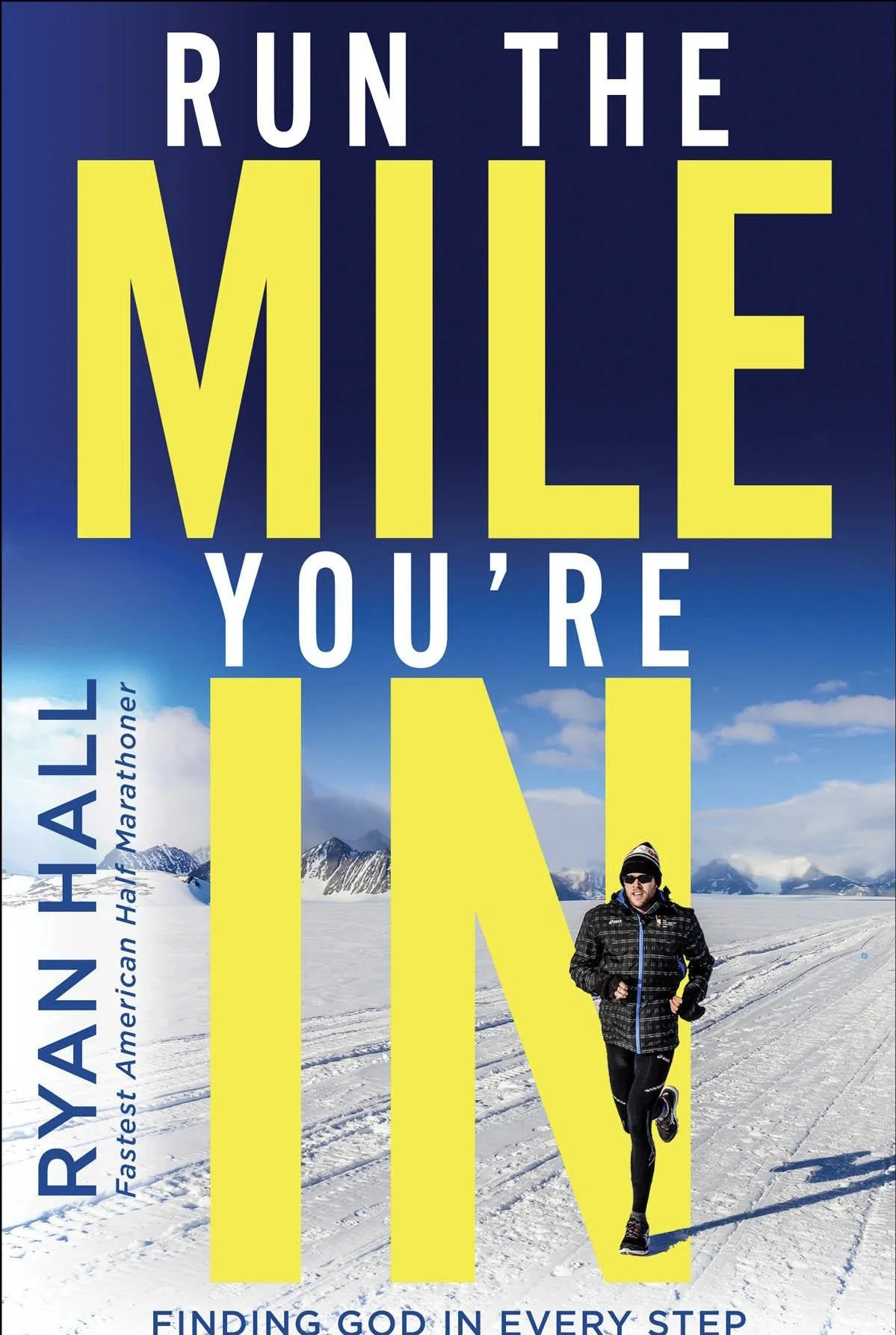
Run The Mile You’re In, by Ryan Hall: Review and Highlights
Never run alone.
Ryan Hall knew this from his first run in the eighth grade: a 15-mile jaunt around a lake, prompted, he says, by the Holy Spirit. From that day forward, he’s led an incredible life in running—Olympic athlete, world-record holder in the half-marathon—chasing the vision God gave him as a teenager.
Hall never ran alone—his faith was always with him—but that doesn’t mean his path was easy, or always clear, or without devastating setbacks.
“Run The Mile You’re In” is set up in 26 chapters, one for each mile of the marathon. Each conveys a hard-earned lesson in faith, seasoned with the time and perspective to look backwards to see how God was always leading him forward and deeper in relationship with him.
Hall’s book is loaded with insights and inspiration. Here are key lessons I took away.
Small promptings by the Holy Spirit can lead to big things—if we respond
We shouldn’t ignore intuition and shouldn’t be afraid to act on it:
If I hadn’t acted on my God - given vision to run around the lake, I never would have had the opportunity to run at Stanford, meet my wife, compete on two Olympic teams, travel around the globe, and live out all the amazing experiences I’ve had as a result of running. And all of this came from a God - inspired seedling of a thought, one that I could have easily dismissed.
Moving forward with the prompts we receive can be life-changing.
God is more concerned with the posture of our heart than the outcomes of our actions
Hall was discouraged when he fell short of his performance goals. Eventually, he felt prompted to move to another kind of goal: setting the correct attitude and mindset, and maintaining that through training and competition regardless of outcomes.
I shifted my focus from performance goals that I couldn’t control to heart goals that I could control and live out every practice, every race, every day. I discovered that for me to perform at my highest level, I needed to believe that anything is possible with God — and that I could trust Him completely with the outcomes of my competitions — but that my focus needed to be not on my performance but instead on my heart.
Find peace by releasing your expectations of how God will move
Anyone with faith struggles with this. We want God to move in our lives in a specific way and right now.
God has other ideas. Other lessons to teach us. So we fail to trust him, getting frustrated and disappointed because he’s not doing what we want, when we want.
But what he wants is for us to trust him. To trust him above our own desires. To trust him above our circumstances.
At times , frustration led me to focus not on what God was doing but rather on what God wasn’t doing that I expected Him to be doing. It can be very easy for me to build a case against God , and when I do that, my relationship with Him isn’t very healthy.
Hall’s shift matured him and deepened his faith. He held fast to this idea:
no matter what happens, have a heart that is unoffendable toward Him.
God knows better than we do.
Build monuments to the times God helps and leads us.
One way to build trust in God is to remember all the times God has stepped in and helped us.
My collegiate career, as well as my entire running career, endured because of a few glimpses of hope, glimpses that I felt God gave me to encourage me to keep going and pursue my vision and my dream of one day running with the best runners in the world. I felt that God was clearly instructing me to build “monuments” around these glimpses of hope much in the same way He instructed Israel in the Old Testament to build monuments (a pile of rocks, in this case) at places where God did remarkable things for Israel.
When things don’t go our way, it’s important to remember the times God has helped us. Personally, I do this with journaling. I started a “3G Journal” this year, recording moments of growth, gratitude, and grace.
At the end of this year, I’ll be stunned by how often God showed himself in my everyday life. And I’ll have stronger faith for having noticed, recorded, and reviewed those moments.
Many ways to build monuments. Journaling is a great one.
If you’re a person of faith who is into fitness, I’m sure you’ll enjoy this quick and powerful read. Even if fitness isn’t your thing, though, Hall has much to share about how to navigate this race called life—and how to never run it alone.
Kindle highlights for Run the Mile You're In
My highlights from Run The Mile You’re In.
Mile 1: Vision
I could hear was God giving me a desire I’d never had before. I felt like He was giving me the aspiration to run around the lake. The desire wasn’t overly obvious; it was more as if I had an itch that could be relieved only by attempting the feat.
If I hadn’t acted on my God - given vision to run around the lake, I never would have had the opportunity to run at Stanford, meet my wife, compete on two Olympic teams, travel around the globe, and live out all the amazing experiences I’ve had as a result of running. And all of this came from a God - inspired seedling of a thought, one that I could have easily dismissed.
We then began the run with a walk, which became my custom throughout my running career, of about 100 meters as a way to warm the body up before beginning a slow jog.
my immense fatigue had quieted my mind and all of the distractions around me and the only thing left was His voice.
I discovered that when I am exhausted , I can more easily pray and — more important — hear His voice .
God spoke to me that I would one day run with the best runners in the world and that I would also be given the gift of helping others through my running.
Mile 2: Purpose
I believe that we each have a mission to accomplish and that we have been designed in such a way that we are not lacking anything to accomplish it. Everything we need is already inside of us. We just have to find it and figure out how to cultivate it.
I believe that He wants to show us what we were created for more than we want to find it, so He is going to reveal to us that purpose. Our job is simply to watch for it and act on it.
Mile 3: Sacrifice
As you train harder and harder, you must adjust your mind to believe that you aren’t training as hard as it wants you to believe it is. That’s why training in a group can be so powerful.
once we cease to be impressed by the size of our challenges, our ability to overcome them grows exponentially.
Achieving our fullest potential in any endeavor requires focus, which is made possible only through sacrifice, because focusing completely on one thing requires that we take our eyes off everything else.
I walked through the quad one day, I said a silent prayer to God. I told Him that because I didn’t have any friends, I needed God to be my friend. It was in this loneliness that my faith went from a belief in God to a relationship with Him.
sacrifices seem like sacrifices only at the time you make them. Sacrifices are things God is calling us to give up for our own good.
the way to enter my God - given destiny is through the door of focus, which can be opened only with the key of sacrifice.
Mile 4: Goals
I had given everything inside of me to achieve my goals in high school only to fall well short of them. And so I thought that maybe I had been pursuing the wrong goals.
I shifted my focus from performance goals that I couldn’t control to heart goals that I could control and live out every practice, every race, every day. I discovered that for me to perform at my highest level, I needed to believe that anything is possible with God — and that I could trust Him completely with the outcomes of my competitions — but that my focus needed to be not on my performance but instead on my heart.
“Guard your heart above all else, for it determines the course of your life ” ( Prov . 4 : 23 NLT ).
It may seem counterintuitive to believe that heart goals are more powerful than performance goals, but I’ve experienced it to be true. Jesus was more passionate about people’s hearts than about their behavior. Over and over, Jesus encouraged His followers to pay attention to their hearts.
My approach to setting goals of the heart was to pick one heart condition I wanted to go after in each competition. A heart goal would be running the Boston Marathon out of a heart of courage, knowing that if I already have Jesus, there is nothing better to add to my life than what I already have . A goal like this enabled me to run free of failure and full of courage.
to achieve my heart goal, I needed to put it in the forefront of my mind, similar to how I used to put times or places I wanted to achieve in the forefront of my mind. A way to do this was to turn that goal into a declaration or mantra that I repeated as I ran.
“For the eyes of the LORD move to and fro throughout the earth that He may strongly support those whose heart is completely His. ” I want my heart to be completely His , because there is nothing better than being that intimate with God.
In all things, I want to think about my heart more than I think about my performance.
Mile 5: Failure
Moving forward involves having a vision for your future that is bigger than the heartbreak you are going through.
God is the ultimate Father and will never fail us. He shows up exactly how we need Him to in every situation. We just need to take off the glasses of our expectations so we can see Him.
I like to look at failure as resistance training. Now that my hobby is weightlifting, I realize more than ever that the best way for me to get stronger is to fail.
We can experience failure for years and years . I think about Joseph in the Bible enduring imprisonment for years before realizing his God - given dream to help protect God’s chosen people from the famine that was to come.
Moses fleeing Pharaoh , only to hang out in the desert for forty years before acting on his mission to lead Israel out of slavery.
Mile 6: Positive Focus
Whatever we fix our minds on grows
My pastor, Bill Johnson, often says, “ I can’t afford to have a thought about myself that God doesn’t have about me. ”
Even if you can easily shake off a person’s negative comments, I would still argue that it is better not to surround yourself with such people or even to view their comments. The wrong people can so easily distract us from our God - given mission.
Like Jesus , we must be set on pleasing God and no one else.
let us focus on the delight of our Father as we walk securely and confidently
Mile 7: Humility
opened up my heart and mind to the idea that God hadn’t designed me to be a miler. I dabbled in longer races, and I discovered that when you’re functioning within your giftedness, things click.
if I start with a little — maybe just one small step in the right direction — those virtues will grow. Discipline begets discipline. Self - control grows self - control. Patience results in more patience.
A beautiful thing happens when we let go of our pride and trust our creator. When we trust, we experience peace — the peace of not having to be in control, the peace of knowing that God is good and has good plans for us.
I don’t necessarily think that while I focused on shorter distance races, God caused all my struggles in order to wear down my pride. I see them more as a natural consequence of having pride in my heart.
He is much better at showing me the way than I am at determining it on my own.
Mile 8: Relationships
Funny how the little things in life — like signing an autograph with a Bible verse — can lead to such significant alterations in the trajectory of our lives , like who we’re going to marry.
He created us so we could be in relationship with Him . Even apart from creation , God is in relationship with Himself (God, Jesus, and the Holy Spirit ) .
we need to look at our relationships and not our accomplishments as our true legacy.
God answers me over and over that greatness comes in the context of and through community.
serving others , especially when you’re doing it in your area of giftedness , is one of the most gratifying and satisfying things you can do in life .
Mile 9: Identity
“What’s the last thing you knew , beyond a shadow of a doubt , that God called you to do? ” My mind flitted back to the day I had sat in the beautiful Stanford Memorial Church and asked God for wisdom about where I should go to college.
I hadn’t finished what God had sent me there to do.
Even though I can hear from God, get a sign from God, and even receive a word of prophecy, I can still doubt myself. The question is this: Why do I doubt myself despite all God has told me and shown me?
often my biggest problem isn’t what is happening in my life. Rather, it is how I see myself.
start by asking, “ What is true about me? ” Better yet , ask, “ What is true about who God is, and what does the answer to that question show me — who has been made in His image and likeness — about who I am?”
Mile 10: Belief
prepare simple declarations to counter the negative thoughts that go through your mind when things get tough.
My job is to put out the fire of self - doubt and declare what is true about that runner and guide them to a place where they can speak powerful truths over themselves.
Mental toughness starts with the belief that you are mentally tough, and it is nurtured through positive declarations.
“ For as he thinks within himself, so he is ” ( Prov . 23 : 7 ).
We do need to practice discernment, but we also must believe that God wants to communicate with us and is speaking to us. We must believe we do hear from God.
Mile 11: Success
My collegiate career, as well as my entire running career, endured because of a few glimpses of hope , glimpses that I felt God gave me to encourage me to keep going and pursue my vision and my dream of one day running with the best runners in the world . I felt that God was clearly instructing me to build “ monuments ” around these glimpses of hope much in the same way He instructed Israel in the Old Testament to build monuments ( a pile of rocks , in this case ) at places where God did remarkable things for Israel.
I forget the times God has shown up in my life unless I mark them by writing about them,
As I focused on the positive things He had done and remembered the vision He had given me for my future, I was able to muster the strength to pick myself up off the ground and continue to put myself out there.
At times, frustration led me to focus not on what God was doing but rather on what God wasn’t doing that I expected Him to be doing. It can be very easy for me to build a case against God , and when I do that, my relationship with Him isn’t very healthy.
Monuments are just that — reminders that we should be thankful for what God has done in our lives.
When I got back from those races , I would “ retire ” the jersey and shoes in my closet . Every time I got dressed in the morning , I’d see my singlets and shoes as monuments to what God had done,
Mile 12: Comparison
one of the biggest lessons God taught me : stop competing.
I love how Jesus responds to Peter’s comparing himself with John : “ You follow Me. ” That’s the same response I felt God giving me whenever I compared myself with others.
if we focus on Jesus and our journey, and are thankful for what God is doing and has done in our lives, then good things almost always happen.
the best way to compete is to strive for personal excellence.
Mile 13: Celebration
In training , you want your body to feel like a sponge. You want to feel like you are absorbing all of the hard training , and you should be noticing that your workouts are slowly getting better.
During my short run , I felt like the Holy Spirit was telling me, “ I want you to celebrate like you just won the Olympic Trials. ” My response was something like, “ Are you serious? ! ” In my emotional and physical state, I couldn’t have been farther from feeling like celebrating. Yet again I forced myself to obey,
I felt something shift and my depression began to lift .
Despite my negative reaction to the encouraging word, though, I continued to feel the shift that was slowly happening in my spirit.
It’s not always instant. Sometimes that shift takes awhile.
even though I didn’t have the faith to partner with the word I had been given, I could align myself with the faith of someone who did believe in God’s power to change my heart and my body.
I think perhaps the reason God is able to laugh at life’s circumstances is because He knows what is going to happen in the end . He sees the whole picture.
When we are battling tough circumstances or fighting depression , we need to ask God to show us the end.
we have access to this future knowledge much in the same way that the guest preacher had access to a prophetic word over my future.
God may not give us a video play - by - play , but He can restore our focus on the big picture instead of on the small , day - to - day happenings that can trip us up.
And the more we partner with God to see our circumstances the way He sees them , the more hope we are filled with and the more empowered we will be to live our destiny.
Mile 14: Unoffendable
Their devotion, love, and affection toward God could not be broken by results. No matter what God chose to do and no matter whether they liked His decision , nothing could change their hearts toward Him.
a miracle that happens in the physical is amazing, but it won’t last forever, whereas a miracle that happens in your heart, if cultivated, will last for a lifetime.
I still don’t fully understand why things played out the way they did that day, but I can clearly see how close and present God was as I endured the flames that threatened to consume me. I could have walked away from my first Olympic experience bitter, frustrated, heartbroken, and angry at God , but He was in the furnace with me, helping me navigate the rocky road faced by all Olympic athletes who find themselves finishing off the podium.
Waves of discouragement hit me from time to time through the following months, but I always came back to what God taught me about being unoffendable toward Him as I trusted in His goodness.
Removing my expectations of how I want God to show up and shifting my eyes toward what God is doing in and around me is a daily goal, because I see this as the primary way I can be thankful to God rather than offended toward Him.
no matter what happens, have a heart that is unoffendable toward Him.
Mile 15: Pain
I found myself asking God how to handle pain, and eventually I felt He led me to Hebrews 12 : 1 – 2 : “ Therefore , since we have so great a cloud of witnesses surrounding us, let us also lay aside every encumbrance and the sin which so easily entangles us, and let us run with endurance the race that is set before us, fixing our eyes on Jesus, the author and perfecter of faith, who for the joy set before Him endured the cross, despising the shame, and has sat down at the right hand of the throne of God. ”
When He gave up His spirit on the cross , He called out , “ It is finished ” ( John 19 : 30 ) , and all of humanity now had access to God through Jesus ’ blood , as was made evident by the tearing of the veil in the holy of holies
The Cost of Discipleship . Bonhoeffer says that we shouldn’t look down the road ahead at what is too hard for us , but rather we should set our eyes on Jesus , who is right in front of us , and say , “ He leads the way ; I will follow . ”
God always supplies , by His grace , all the strength we need for each moment to accomplish His purposes .
I need to remind myself to just run the mile I’m in .
I’ve had to learn to let my performances flow out of my body rather than try to force them to happen . It’s all about having the mentality that my best performance wants to come out , and all I have to do is let it come out .
when it feels like the pain is encompassing you , go into your mind’s eye and picture the suffering Christ on the cross , who was thinking of how much He loves you . Letting our hearts and minds fill with love is the most powerful
Mile 16: Faith
to begin what I called faith - based coaching . I began this journey because I sincerely believe that God has all the answers to everything in life , with no exceptions —
The first lesson God taught me as my coach is that greatness comes forth from community .
When I started out with God as my coach , I would sit down with a pen and paper and ask Him questions . This was a bit of a transition for me , because my prayer times were usually more like my talking at God than my giving Him space to speak back . But I’ve discovered that if I’m not asking God questions , I’m not creating room to hear Him .
Sure enough , though , when I started asking Him questions , He started answering them . And one of the first questions I asked God is , Where does strength come from ? The answer wasn’t what I expected or even wanted to hear : rest .
It is vain for you to rise up early , to retire late , to eat bread of painful labors ; for He gives to His beloved even in his sleep ” ( Ps . 127 : 1 – 2 ) .
When it came to planning my daily training , I was hoping that God would give me all kinds of crazy dreams and visions of the perfect workouts I needed to be doing , but that wasn’t my experience . Instead , I felt God reinforcing that He had already brought some amazing coaches into my life to teach me the foundations of training .
I discovered that learning to hear from God is a lot like learning a second language . You first have to spend time listening and trying to decipher what you’re hearing , and you’re guaranteed to make some mistakes in the process .
I’ll be the first to admit that some things I thought I was hearing from God weren’t coming from Him at all . For example , prior to the 2012 Olympics , I felt God was telling me that all of the pieces of the puzzle were going to come together and I was going to run my best race ever .
Quite the opposite happened , and I ended up dropping out for the first time ever because of a hamstring tear .
Hearing from God is like anything else in this life — it takes practice , and most likely we’re going to get it wrong from time to time — but failure shouldn’t discourage us from hearing His voice and lead us to just settle for
Failure to hear God correctly should just be instructional and lead us to more accurately hear Him in the future .
One of the greatest lessons I learned about hearing God’s voice had to do with my heart condition in both training and racing : how you do what you do is more important than what you do .
I was concerned about what workout I was going to do that day , whereas God was concerned about what was going on in my heart while I was doing the workout .
we’re concerned about what is happening on the outside , while He’s concerned about what is happening on the inside .
Running with a heart secure in who I am allowed me to find the sweet spot for my body .
It might appear that the last years of my career proved that having God has my coach was unsuccessful , but I would counter that having God as my coach is what helped me navigate and endure the most difficult season of my running . Every athlete reaches the point where their body gives out or just can’t perform at the same level it once did .
Mile 17: Worship
I felt freer and lighter than I had ever felt because my connection with God was so much deeper now , resulting in my feeling more loved by God than ever . When you really experience the love of God , you can’t help but go through life feeling light and free .
being connected to God brings freedom , relaxation , and joy , allowing one to perform at new levels .
sometimes it’s the small things that disrupt our spirits , because often our guard isn’t up with the small things .
worshiping God through anything is simple , really — it’s just doing whatever you are doing with the heart posture that it is for Him .
Mile 18: Declaration
“Truly I say to you , whoever says to this mountain , ‘ Be taken up and cast into the sea , ’ and does not doubt in his heart , but believes that what he says is going to happen , it will be granted him ” ( Mark 11 : 23 ) .
This experience continues to remind me not to put time limits on the dreams I’m believing will happen . I easily could have stopped declaring I was going to run 2 : 04 after failing the first time , but I would have missed that declaration’s fulfillment .
let us not just declare in our weakness ; let us also declare the deepest dreams in our hearts and speak life into every area that seems hopeless .
What even are my deepest, no-restrictions dreams?
Mile 19: Fearless
Coupled with having a secure identity was the vision God had given me for my running . Strong vision plus a secure identity allows you to risk everything without the fear of failure . It’s a potent combination .
Fear has always made me feel heavy and tight . Whenever I was running out of fear , I felt locked up , and nothing good ever came from it .
Mile 20: Love
I found that whenever I believed that maybe I couldn’t do this , I was always right . Whatever I doubted , I partnered with , and that partnership became a reality .
one of my favorite things about being on the starting line was that it felt like a blank slate .
Mile 21: Partnering
Many of the injuries and fatigue issues I battled throughout my career were because I wasn’t good at partnering with my body . I had the wrong mindset of believing that my body and my mind were functioning in opposition to each other , which is common reasoning in the endurance community .
I’ve learned that my body , mind , and spirit are all on the same team , wanting to operate as a unit to accomplish a common goal .
When I started viewing my body as being on my side , I found that I was able to truly listen to my body and get much better results .
knowing God is the true victory we are all so hungry for .
I felt like God was telling me not only that my victories would help others be victorious but also that my disappointments would result in other breakthroughs .
I still tend to force my body to do something because I’m rigidly following a schedule or have some rules in my head about what I should do , whether it’s a nutrition regime or my weightlifting program . The problem with this “ living by the law ” mentality is that it doesn’t allow room for the Holy Spirit to invade and influence how I am living or training .
the goal isn’t to follow a plan as much as it is to follow the Holy Spirit , who is right in front of us and wants to lead us into our own promised land .
consider the areas where we have strict rules in place and ask God if He wants to invade those areas with His guidance .
keep following tried and true principles that have been passed down from generation to generation and to always look to the Holy Spirit to give me moment - by - moment guidance .
Mile 22: Victories
sometimes the biggest victories we experience are not our own . They are victories we can share in because we played a part in someone’s win by encouraging them and supporting them .
Teaching!
When my view of success is so small that it’s all about me and my performance , my life is deeply unfulfilling . But when I open up my definition to include the success of others and the collective , I’m much more satisfied . Rick Warren says in his memorable opening sentence of The Purpose Driven Life , “ It’s not about you . ”
Mile 23: Seasons
prayed for comfort . And I felt God answer , “ It was never meant to last forever . ”
sometimes seasons just end because there is an ending point . Once I was able to remove the shame , I was able to find peace to transition to the next season .
Many of the principles I learned to train for running are also used in weightlifting , and vice versa .
Often , lessons we learned in one season are meant to help us in future seasons , so even if you are coming out of a rough season , take solace in the fact that it was not a waste . The lessons you learned through your trials will help you on your journey in this new season .
Ecclesiastes 3 ( vv . 1 – 8 ) : There is an appointed time for everything . And there is a time for every event under heaven —
we must be able to identify the end of one season so we can enter the new season . Things can get confusing , hard , and frustrating for us whenever we try to drag one season into another .
Mile 24: Consistency
same fatigue I’d felt prior to my retirement . Once again , running was teaching me a valuable lesson : if in a new season you try to do what you’ve done in a previous season , it’s not likely to work .
Mile 25: Closure
My plan for marathons has always been the same : go out hard and give God a chance
always want to give Him a chance to strengthen me .
What I’ve learned since the World Marathon Challenge is that for something to grow , something else usually has to die first .
Mile 26: Victorious
there is nothing I can possess that is more valuable nor is there anything I can accomplish that is greater than knowing God and being in a right relationship with Him .
Copyright © 2022 - Matt Tillotson
Journaling to develop intuition
This tweet got a strong response:

The overwhelming consensus? “Yes, you can.”
Taylor Barada shared an article on creating a decision journal.
Charlie Becker recommended Ray Dalio’s book, “Principles.”
Monica Ricci said bringing awareness to anything allows you to improve it.
How can we use journaling to improve intuition?
Here’s my plan:
Notice intuitive feelings. This requires a habit change and willingness to feel what we’re feeling.
Write down intuitive feelings. This works best in the moment—interstitial journaling—rather than reflective journaling at the end of the day. Intuitive moments are fleeting. Record them as they pass. Apple Notes for the win here, as usual.
Prompt intuition by asking questions. Write down what you hear in response.
Take action on intuition. We can’t just feel it. We have to act and experience outcomes.
Record the results. Over time, patterns should emerge. When did intuition guide us well? When was it just a passing emotional flare?
P.S.: Men are intuitive
Monica Ricci said it best:
It is the exceptional man who can lean into and honor all his emotions, activate and trust intuition, while remaining secure in his masculine energy and strong self-perception.
It’s not that men aren’t intuitive. But we’ve been programmed to ignore or shove down emotion.
And emotion is the engine of intuition.
P.P.S.: Don’t ignore the spiritual side of intuition
Nearly all the responses to my Tweet were thoughtful and focused on mental aspects of intuition.
I believe intuition is fed by a deeper well than intellect alone. We can access something bigger and wiser than ourselves.
You can feed the spiritual side of intuition through prayer—journaling can be prayer—and gratitude. Joyful Journey is a good resource to learn spiritual journaling from a Christian perspective.
Accomplishment doesn’t eradicate imposter syndrome
It never goes away.
Ken Evans invited me to speak to entrepreneurs in the Tampa Bay Innovation Center’s B2B Startup Accelerator. We talked about building in public: sharing the challenges and triumphs of building a new business in real time so others can learn from your experience.
The number one challenge keeping this group from writing and sharing?
Imposter syndrome.
Write of Passage students face the same challenges. Accomplished professionals from Apple, Google, and Facebook. Millionaire entrepreneurs. Published authors. All hear that same voice inside:
“Who am I to share this online?”
Not only are you worthy of sharing online. It’s a moral imperative to share what you’re learning with others. You owe it to people who need to learn from you. You owe it to your business. You owe it to yourself.
If you’re building a business, you have have an amazing opportunity to:
Get instant feedback on new feature and service ideas
Draw people into your company narrative, telling your story step by step
Build new relationships with customers, influencers, potential partners, and media
You’re never going to feel like “it’s time” to publish online. You just do it. You push through the resistance. And then you do it again. To really push yourself, use my 4Ps to create interesting Spiky Points of View.
Don’t hoard your knowledge. Like money, you can’t take it with you when you die. Share it now.
Over 30 and strength train? Lifting less may help you lift more.
Early Monday morning. Your boss calls you into their office.
“Look, to make you more effective, put in half the normal time this week.”
You’re stunned. “I’m sorry, what? I haven’t even sipped my coffee yet ...”
“And your weekly reports? Reduce them by 10-20%.”
That’s the equivalent of a deloading week in the gym. You workout without breaking a sweat and tell yourself you’re doing important work for your physical and mental health.
And you’re not even lying.
Deloading reduces your normal strength training regimen, allowing muscles time to rest, heal, and even grow.
But who should deload, how do you do it, and why bother?
Who should deload?
Just about everyone strength trains consistently for more than nine-ish months. Older lifters especially benefit from deloading weeks.
That said, I didn’t learn about this concept until this year, and I’m 48. Never too late to start slacking off.
How often should you deload?
You should deload every 6-8 weeks.
But listen to your body. You may need more rest than that. If you’re not making gains, consistently lack energy in the gym, or are struggling mentally to maintain consistency, it might be time for an unscheduled deload.
How do you deload?
Don’t spend the week on the couch binging Ozark and Oreos.
Keep moving. But implement a tapered-down version of your normal workout routine.
When deloading, you have three variables to work with:
•Weight (pounds lifted)
•Intensity (reps and sets)
•Frequency (number of sessions / week)
The plan for my deloading week
For my deload week, I’m lowering two variables:
•Weight (decreasing the weight lifted by 10-25%)
•Intensity (reducing reps per set by 50%)
Monday: upper body dumbbell
I zip through this pretty quickly.

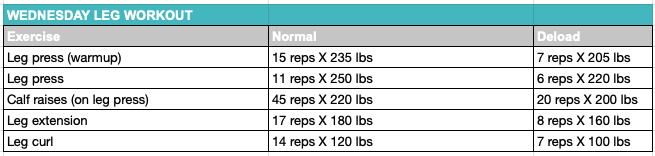
Wednesday: leg day
Leg days during deloading weeks are glorious. All of the purpose, none of the pain.
Friday: upper body machine
The Friday workout is usually my favorite. The deloaded version is a breeze.

What about cardio?
If you do strenuous cardio, back that off during deload weeks. We want to reduce all physical stress on the body, and hard cardio is a part of that.
In my case, I do stationary bike sprints 2-3 times per week. They truly suck, but they are brief.
My normal sprint routine:
30 seconds all-out effort at tension setting 18
20 seconds rest
Repeat X 6
This week, I'm doing three sprints at a lower tension for each session.
On non-lifting days, I usually run and walk 5-7 miles total. On lifting days, I just walk about the same distance.
When I run, I lope along at about a 9:30 per mile pace. Walking is in the 13:30 per mile range. That’s not strenuous for me, and I didn’t adjust it for the deload week.
Why bother deloading at all?
At age 48 deloading helps me:
Reset form and cadence
Get excited about the gym again
Rest recurring areas of soreness: neck, right shoulder, and hips
Remember fitness is a lifelong race, not a series of frenzied sprints
All while sustaining consistency and momentum.
And as I reach the end of the week, my physical energy is up. I have the urge to “do more.” I won’t. Not until Monday.
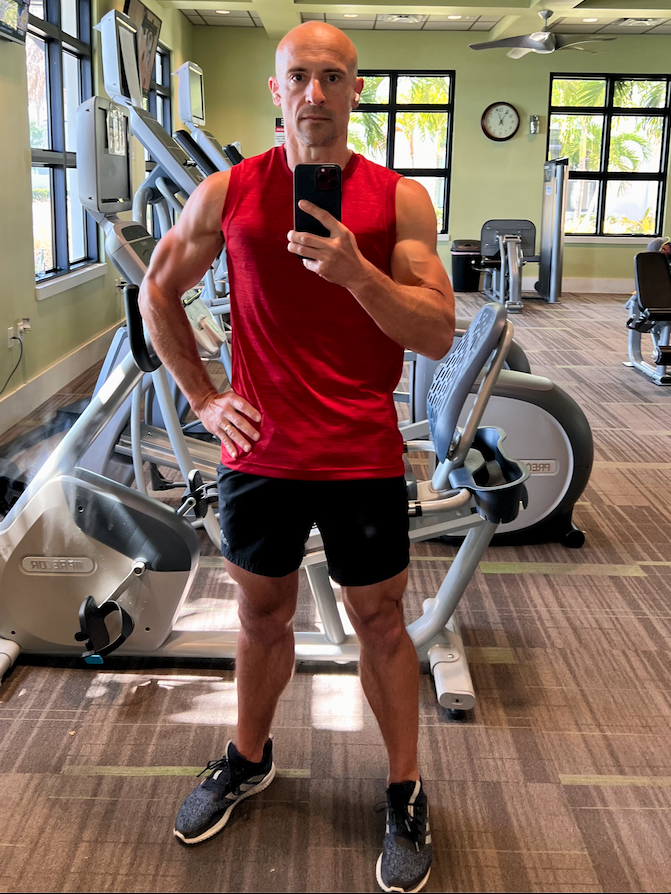
As we age, recovery becomes more important to building and maintaining strength. Joints need time to heal. The mental break from the endless grind can reset your enthusiasm and energy. And you might even make greater gains after the deload week.
If you’re a long-time exerciser, take a load off. You’ve earned it. And your body needs it.
Online writers: frustrated by note-taking? Try more notice-taking.
Sweaty palms. Second-guessing decisions. Despair over a wrong path taken.
Considering career options? Life partners?
Nope. Note-taking for online writers. People stress over this stuff.
I too struggle with note-taking. But I learned, by teaching a session on note-taking in Write of Passage, that my process is different: notice-taking more than note-taking.
Sweat equity: Note-taking and the fitness industry
Like fitness, there are many paths to note-taking success.
Note-taking methodologies and platforms abound. Roam, Obsidian, Evernote. There’s something called Zettelkasten, which sounds like a nefarious spell cast by a German witch.
And like fitness, you have true believers for the various methods. Note-taking has the #Roamcult. Fitness has CrossFit die-hards. Keto believers. Vegans. And on and on.
In reality, sustainable fitness habits require adaptation and customization. You have to experiment and find what works for you. Your best fitness system is probably made up of bits and pieces of many systems.
Note-taking is the same.
Take what works for others. Blend it in with your own ideas. Create a notice-taking system of your own. Try, test, and evolve.
The key tenets of Notice-Taking
Notice-taking captures an idea or feeling in the moment to feel it right now, rather than to recall it later.
Recall is a pleasant side effect of notice-taking. It’s not the main point. My notice-taking system involves:
Journaling, both every morning and at quick and random intervals throughout the day
A more manual process, by design, which creates friction and reduces the total number of notes
Serving my life goals--the system itself is not a goal
Intuition over institutionalism--trying new things and ideas outside the normal process
Connection of notes over conservation of notes--can I connect this to a bigger idea already, or will this sit in isolation? (If it’s in isolation, you’ll probably never come back to it again.)
Experiencing it today matters more than recalling it tomorrow
Notice-taking starts with why
First, get clear on why you want a note-taking system. I have two main whys:
Exercise my faith and gratitude muscles
Create compelling and useful content around fitness and creativity
I’m not highlighting things to save them in a system. I use notes to drive action-oriented goals.
Three components to my notice-taking system
Journaling
I write 500 free-form words every morning: a recap of the prior day, prayers, something about a TV show I watched, or anything else.
No rules. Just clearing my head.
More randomly, I jot down one-liners in an ongoing “Gratitude and Growth log,” noticing things to be grateful for, and moments where I’m growing as a person.
The G+G log is a new experiment this year. I’m excited to review it in December.
I’ve also started a fitnotes page on my website. Short observations and ideas about my health and fitness, inspired by Michael Dean’s logloglog.
Inbox
When I find an article to read, I rarely read it in the moment. Instead, I use this iOS Shortcut to grab both the URL and the content of the article and whisk it away to a folder called “Inbox” in my Apple Notes.
Mostly I pull articles on fitness, writing, and creativity, which are the subjects I write most about. On Thursdays, I batch read articles, pulling things to share in my Friday newsletter, Matt’s Mix Tape.
My inbox serves as a messy database. There are times I want to refer back to something I shared in a newsletter. It’s probably in this folder, and it’s searchable.
Debris
This is a delicious sandwich:

It’s from Mother’s Restaurant in New Orleans. It’s called the “Debris Sandwich” because it's made up of the leftover roast beef that splashed into a massive reservoir aus jus gravy.
It’s fantastic.
(And thanks to its caloric density, you won’t require sustenance for two days afterwards.)
There is value in the Debris. The same goes for notice-taking.
The debris are notes that don’t fit elsewhere:
Client meeting notes
Random observations
Notes from teaching sessions and Write of Passage meetings
And yes, I put it all in Apple Notes.
Notice today over saving for tomorrow

My notice-taking system isn’t about preservation. It’s about noticing things today.
I don’t want to freezerburn ideas that become isolated and unrecognizable. I want to capture thoughts, feelings, and unique ideas that serve my goals, fortify my faith, and strengthen my gratitude.
As Matthew Guay says:
“The action of writing is what counts, what imprints important ideas in our brain. The note itself is a permission slip to let things go.”
Notice-taking is an imprint system, a physical action to drive deeper contemplation and feeling. It creates a richer life, not an overstuffed note-freezer.
The unexpected effects of a free weight workout
Recently, I switched my Monday strength training from machines to dumbbells:
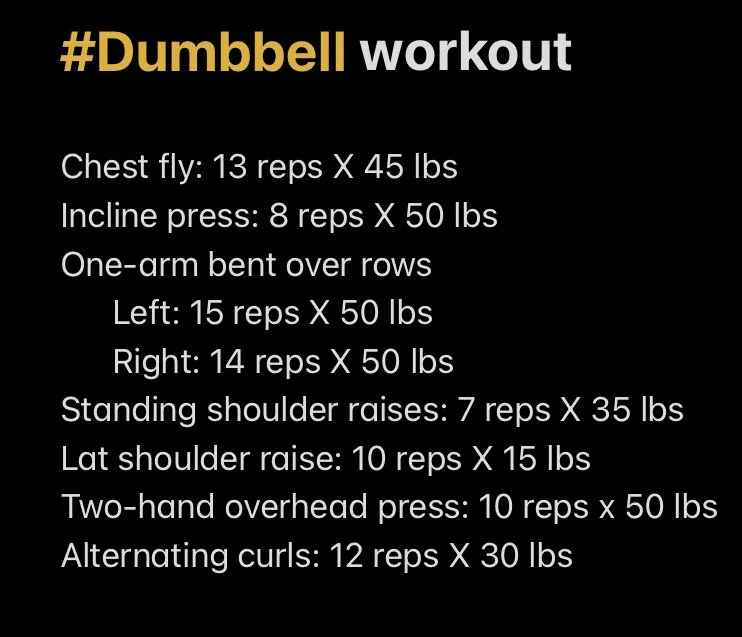
All single sets, done to failure.
Free weight workouts develop stabilizer muscles:
Machines don’t recruit stabilizing muscles the way free weights do since they often require you to move a load in just one plane of motion. With free weights, the load is free to go anywhere. Stabilizer muscles therefore must work to make sure the load is being controlled and moved efficiently—a job that simply isn’t required when working on most machines.
But what is a stabilizer muscle?
When performing an exercise, there are primary movers and stabilizer muscles. Stabilizer muscles are tasked with stabilizing the body and extremities during multiplanar movements, while primary movers are the muscles doing most of the work.
I’ve noticed this with my forearms, which are becoming more defined:

I’m still pro-machine-workouts. Some studies suggest you’re less likely to get injured using machines. And they’re convenient. I use machines for legs and my Friday upper body lifts.
Mostly, though, I’m pro-experiment. This one seems to be paying off.
Six lessons learned writing 137 newsletters
In May of 2019 I published my first newsletter. It was called “Writing Matters.”
The content sucked as much as the title.
Today, Matt’s Mix Tape helps middle-aged people use fitness and writing to remix and recreate their lives.
One-hundred and thirty-six editions later, here are six lessons learned.
First lesson: let it suck for awhile
My first newsletter sort of apologized for existing. It didn’t know what it was, or where it was going.
The audience was small. And that was good, because we only improve by publishing. And a small and loyal audience will stick with you as your newsletter evolves and improve.
Second lesson: Slow growth is good
For the first year of publishing, I added no new subscribers. I personally invited 50 or 60 people to my list and then nothing changed. My growth curve was Nebraska-flat:
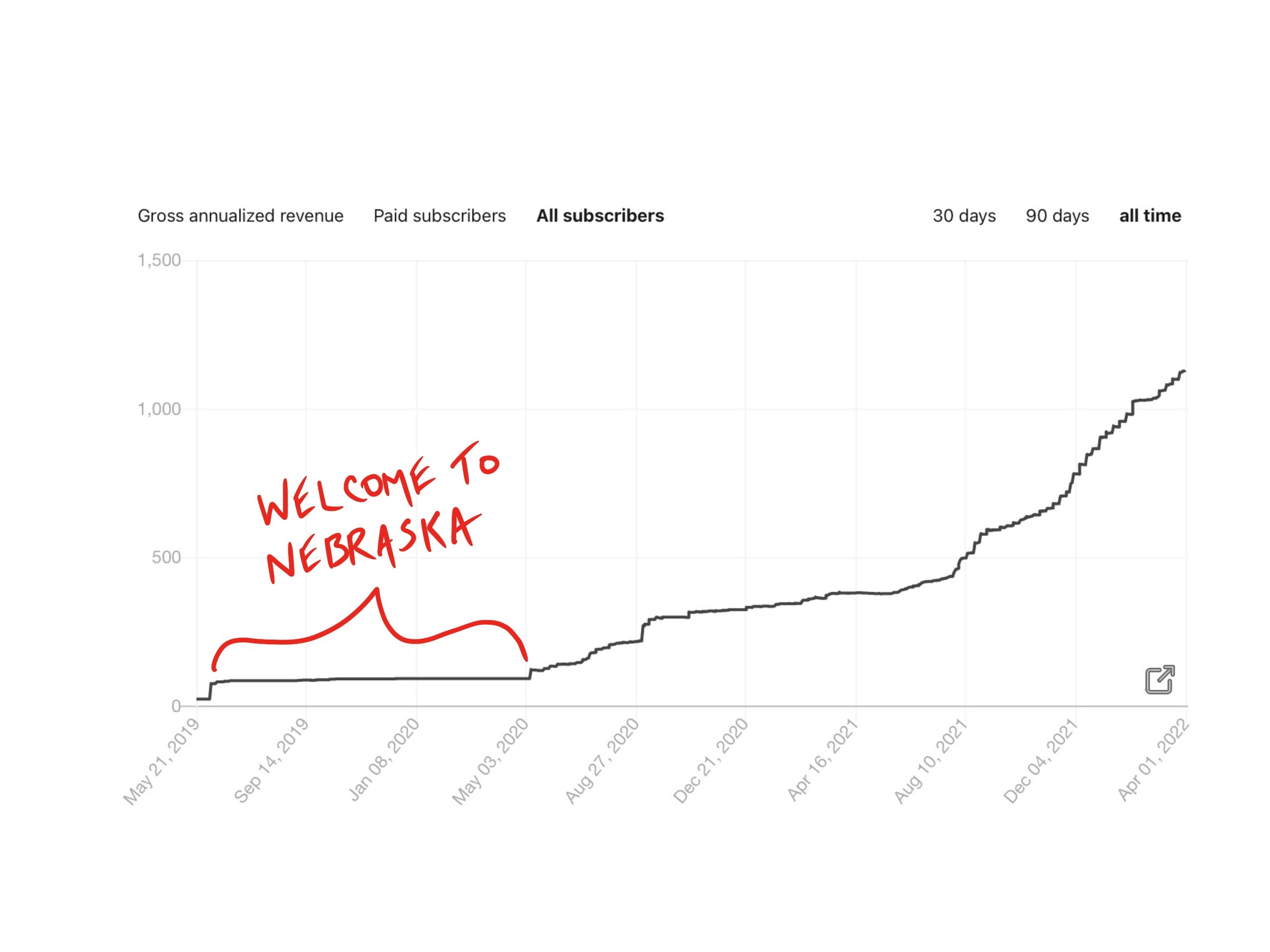
But that was ok.
I didn’t know what world I was building, as we will talk about in a minute.
I was practicing, learning, improving, and serving a small audience --but most importantly serving myself.
Third lesson: Write for yourself
On the Tim Ferriss podcast, Maria Popova, who writes The Marginalian to millions of readers each week, said:
“Write for yourself. If you want to create something meaningful and fulfilling, something that lasts and speaks to people, the counterintuitive but really, really necessary thing is that you must not write for people.”
--Maria Popova, The Marginalian
Two reasons you must write for yourself:
First, you can’t sustain this journey otherwise. It’s too much work to write every week about things that don’t light you up, things you’re not living out in your own life.
Secondly, enthusiasm and passion are the only thing corporations, copybots and ghostwriters cannot replicate. Not sustainably. Not in the long run.
Writing for yourself is a built-in competitive advantage. People—the right people—will sense your enthusiasm and be drawn in.
But there’s a caveat: Be useful.
Writing for ourselves doesn’t mean we’re selfish, or self-indulgent
We still want to share things that are valuable, interesting, and concise. Austin Kleon nails it with this diagram:

Fourth lesson: If you miss an edition, just start again
In February 2020, I went through a grueling interview process for a job I really wanted.
I’d interviewed with the entire C-suite of this company more than once. They’d sit around a table together, and politely pelt me with question after question.
It was a long and brutal process.
After the last interview, they enthusiastically said they’d get back to me in just a couple of days.
I thought I’d nailed it. We were going to move. My dad had just had quadruple bypass surgery and we would be far closer to him and the rest of my and my wife’s families.
It was all coming together. Or so I thought.
Two weeks later: rejection via email.
The same day, I was turned down for another role I’d interviewed for at another company. And then COVID hit.
I stopped writing.
I didn’t publish for five weeks. I didn’t feel like I had anything more to say. The newsletter felt pointless. And I felt deflated.
But after those five weeks, I started up again.
I didn’t apologize. I didn’t mention the gap at all. No one said a word.
I’ve now published 100 weeks in a row.
No one really cares if you miss. And if they did, what are they writing? Statistically speaking, almost certainly nothing. Their criticisms don’t count.
If you miss, just get back on the horse and ride again. No apologies, no excuses.
Fifth lesson: Individuality emerges over time
When you keep riding that horse, you’ll find your individuality emerges over time. So pay attention to what annoys you about your own newsletter. That’s your growth path.
For example, I was annoyed by this logo:

Boring!
And I couldn’t find anything to replace it.
Then I did this. Even worse. What the hell even is this?

Then, Nate Kadlac taught me to use Procreate. So I started doing my own logo every week:

Then I took Nate’s course, Approachable Design, and learned about color palettes. I started consistently using brown and turquoise as my anchor colors.

Now I have a unique and consistent thing in my newsletter every week.
There is no zero chance I could have planned in advance and said, “You know, I’m going to doodle inside a template of a cassette tape every week.”
Completely unpredictable. No way to plan that.
Let things evolve. And pay attention to what bothers you about your own newsletter. Lean into that annoyance. It lays the path for your own uniqueness--for your own world building.
Final lesson: Build a new world
Maybe you’ll take off like a rocket ship, like Packy McCormick did with Not Boring.
Packy quickly built an audience and sustainable business writing about startups.
I highly suggest you read Packy’s essay on The Great Online Game. Packy talks about newsletters as a world-building tool illustrated through the example of Alex Danco who built Dancoland.

Alex literally drew the world he wanted to create and explore in his newsletter.
If you’re going to grow slowly and deliberately, what kind of world do you want to build?
As for Matt’s Mix Tape, I want to build a world of Gen Xers and Millennials in the best shape of their lives, creating great stuff. Growing and improving in midlife. Not coasting. Not deteriorating. Improving, physically, mentallly, spiritually.
Like my newsletter, I want my audience to gradually improve with time.
I hope your newsletter does, also.
Spiky Points of View: Use the 4 Ps
How to be provocative without being a troll
In my Write of Passage mentor session last week, we created Spiky Points of View (SPOVs.)
Wes Kao created the SPOV idea and defines it this way:
A spiky point of view is a perspective others can disagree with. It’s a belief you feel strongly about and are willing to advocate for. It’s your thesis about topics in your realm of expertise.
Write of Passage is not not a hot-take factory. We want people sharing intellectually rigorous ideas rooted in personal experience. Good SPOVs fit this bill.
The Four Ps of SPOVs help create useful and unique SPOVs:
First P: Spiky Points of View are Personal
Credible opinions come from your own life:
Family
Career
Hobbies
Conversations
Educational experiences
Travel
Ground your SPOV in personal experience.
Second P: Spiky Points of View are Polarizing
Your SPOV should have a logically defensible counter-position. People should be able to argue against it.
Your SPOV is not Spiky if everyone agrees.
Third P: Spiky Points of View are Profound
Your SPOV should surprise us by reframing or refuting a generally accepted idea.
Take on an accepted truth. Reshape it.
Fourth P: Spiky Points of View are Purposeful
A good SPOV serves the reader’s best interests. Don’t just aim to trigger emotions.
Your SPOV should help people see the world and move through it in a new way.
An SPOV Example
Here’s one from Wes:
When you teach online, many people assume they’re 100% an instructor—but you’re actually 50% an instructor and 50% an entertainer. Attention spans are short and the responsibility is on the instructor (not the student) to help students understand why they should care.
I agree with this one. Zoom has a big red button that screams LEAVE and I’m acutely aware any student can replace me with cat videos at any moment.
Spiky Points of View do not exist just to shock or anger people.
(Although they might elicit those feelings.)
Political and sports hot takes are not SPOVs. They are lowest common denominator content designed to stoke outrage.
SPOVs offer a new and better way to think and do. They add value to the world’s conversations.
Here’s my fitness routine. But it doesn’t matter.
You ask, I deliver.
After last week’s newsletter, a few readers asked me to share my workout routine.
I’m happy to do it. But also reluctant.
Because it doesn’t matter.
What works for me right now is not what will work best for you. But if I discuss the philosophies behind my current routine, that might be helpful.
Please treat everything in this article as personal observation, not advice.
Why doesn’t your workout routine matter?
Here’s the big secret about effective strength training:
Bodyweight exercises work
Free weights work
Weight machines work
Even tensing your muscles—using no weight whatsoever—can work.
Everything works. Especially when you’re just starting out.
The key is consistency.
You have to create a program, or a variety of programs, that will allow you to show up over and over again.
That’s the secret sauce. Consistency.
Who the hell are you to talk about this?
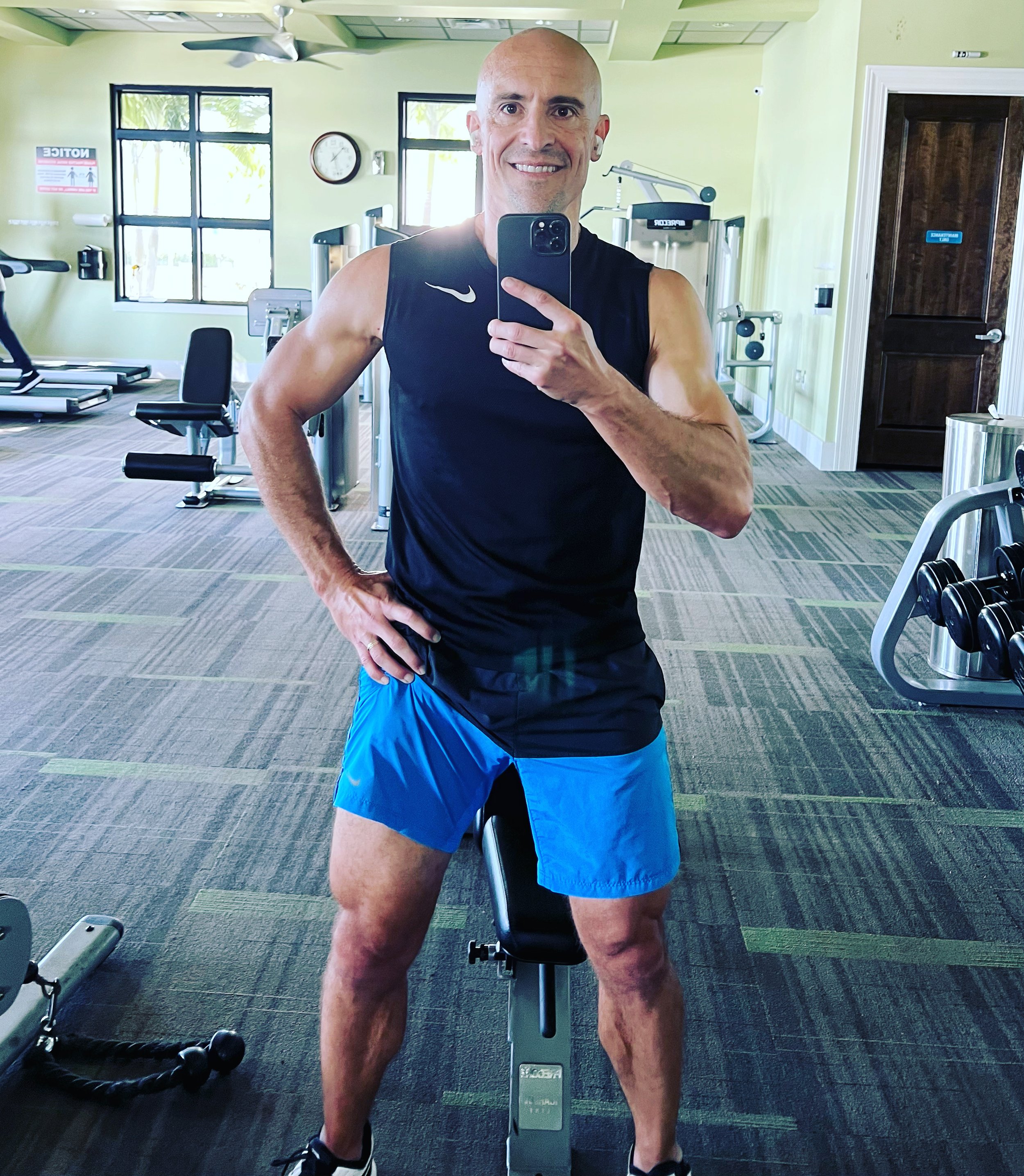
An excellent question, or, if stated rhetorically, an excellent point.
I am not a doctor or a certified trainer.
I’m a guy who’s stayed active for 30 over years. I try new stuff. Now at age 48, I can look around and see I’m doing pretty well on the strength and leanness fronts.
That’s it.
Strength training: Why do you only use machines?
Because machines are most readily available to me.
There’s a small gym in our neighborhood community center. It’s a one-block walk. There is no excuse to skip and zero friction to getting there.

In other words: the easy access to machines fosters consistency.
Also, there’s some thought that machines may leave you less susceptible to injury--a huge consideration and goal for those of us huffing and puffing through middle age workouts:
Machines have less risk of injury because you're not freely moving a weight around, and you can give your aching body parts a rest," he says.
Take that with a grain of salt.
But—knock on wood—my only gym injury occurred when I was using poor form with free weights--and swinging around too much weight.
What’s your philosophy on reps and sets?
I like my strength training philosophy like I like my music: mostly from the 1970s.
Arthur Jones, the founder of Nautilus, created his high-intensity training (HIT) philosophy in the early 70s and I loosely follow his principles.
HIT emphasizes strict form and peforming sets to momentary muscle failure. Time-under-tension (TUT)--the time the muscle is at work--is critical. Intensity of effort, not the number of sets, is key.
Repetitions should be done slowly, with at least a three-count through both phases of the motion. No resting at the bottom of the lift. No locking out at the top.
Using this method, you’ll get--in theory--maximum results from a single set. (I do perform some extra sets for some lifts when I’ve hit a plateau.)
In short: work hard, briefly, and under strict control as you take the set to momentary muscle failure.
If you’re interested in learning more about high-intensity training:
Wikipedia has a detailed High-Intensity-Training overview
The book “The New High-Intensity Training” goes much deeper into the underpinning philosophies and science of HIT, and includes tons of potential exercises.
HIT can be done with machines, free weights, or bodyweight exercises.
OK, for heaven’s sakes, what is the strength training routine?
Upper body: Monday and Friday
Incline bench
8 or 9 reps X 240 lbs
10 X 170
Shoulder press
4 X 190
6 X 150
8-9 X 130
Bicep curls
7-8 X 150
4-5 X 160
Rope lat pulldown
7-8 X 140
Facepulls
10-12 X 90
-or-
Standing rows
10-12 X 130
Bar raises
9-11 X 170
Legs: Wednesday
Leg press
12 reps X 235 lbs. (warmup)
9 X 250
Calf raises
40-50 X 190
Leg extension
15 X 180
Leg curl
13 X 120
Rinse and repeat. I now incorporate a “deload” week--same routine but at lighter weights--every six-ish weeks to promote muscle recovery.
What about cardio?
For thirty years, I was a highly amateuer runner.
I started running in high school, so I wouldn’t get winded sitting on the bench as a mediocre football player.
After high school I kept going.
I’d run 4-6 days a week, usually 4-6 miles, lollygagging along at a 10-12 minute pace.
But recently some friends around me, fellow joggers, started getting hurt. Knee problems. All those miles pounding on the pavement, decade after decade--they began to weigh on me mentally.
My knees were fine. But my hips were stiff. I started to feel I was gambling with my future mobility.
As we reach middle age, we have to start considering our long-term mobility.
So I stopped jogging. A thirty-year habit, over. Cold turkey.
What happened?
You can read more about that here, but in short: I lost weight when I quit jogging.
Now my cardio routine looks like this:
Bike sprints: Tues-Thurs-Sat
30 second sprint, 20 second rest, 6 rounds. (You can read more about the benefits of sprint intervals here.
Walking: six days per week
Walk at least 4 miles, usually all at once, sometimes broken up into multiple sessions.
The holes in my workout routine
I don’t have it all figured out. And never will.
First, my flexibility is bad. Envision and apply the expected flexibility limits for a 48-year-old-guy.
I fit the stereotype.
I don’t have a reliable, consistent stretching routine. I’m working on that.
Secondly, my strength training isn’t optimized to work all the muscle groups I should be working. I probably need a coach or other outside input for that.
Third, I should vary my workout intensity as I age. It takes longer to recover from workouts now. I doubt I’m accommodating that very well.
I tend to do the exact same things every week. I’ve recently learned about deloading, and took an “easy week” last week. I plan to do this every six weeks.
The two most important takeaways
Hopefully, you see why my individual workout routines do not matter for you.
Please remember just two things:
First, consistency is 90% of the battle. Show up!
Second: experiment, carefully and safely, and probably, unlike my trials, under expert guidance.
We’re not all the same. We need to build different workout routines that address both our physical and mental needs.
Crafting a program you’ll do over and over is so important. And that looks a little different for all of us.
Now I’m off to the gym. It’s a block away. No excuses.
Thanks to Florian Maganza and Cam Houser for their edits and insights on this essay.