

How AI Can Turn 26,624 Kindle Highlights Into a Searchable Brain

“The End of Reading is Here,” trumpeted The Atlantic headline.
My immediate thought: “Good. I’m going to read more. And write more about reading more.”
But the headline missed both the true point of the article and the impact of the trend.
Reading isn’t dead. Instead, it’s retreating from the general population, and growing in concentration amongst ~20% of us, who are reading more:
Last year, print-book sales were higher than they were a decade ago. Barnes & Noble opened more than 60 new stores. Almost 400 independent bookstores sprang up in 2025.
Older Americans, college grads, and women are driving book sales today.
Some of us will continue to read (and write) a lot, and benefit greatly from it. Most people will enter a post-literary, video-and-audio only age. That doesn’t mean people won’t know how to read at all. They just won’t choose to read. And then reading comprehension, writing quality, the way we think and share information — that all gets worse.
Our literate society was, the theory goes, just a moment in time.
Not only will I read more, but I want to get more out of my reading. I want to share insights and sparks and weird idea connections with others who also want to keep their book brains switched on.
Part of that is better mining material I’ve already read.
For example, my Kindle library has 484 books in it today.1 I use the Kindle app on my iPhone, iPad, and Mac regularly. It’s a much better reading experience than a book.2 Easier to read in bed, or while eating, and it’s easier to highlight passages that surprise me.
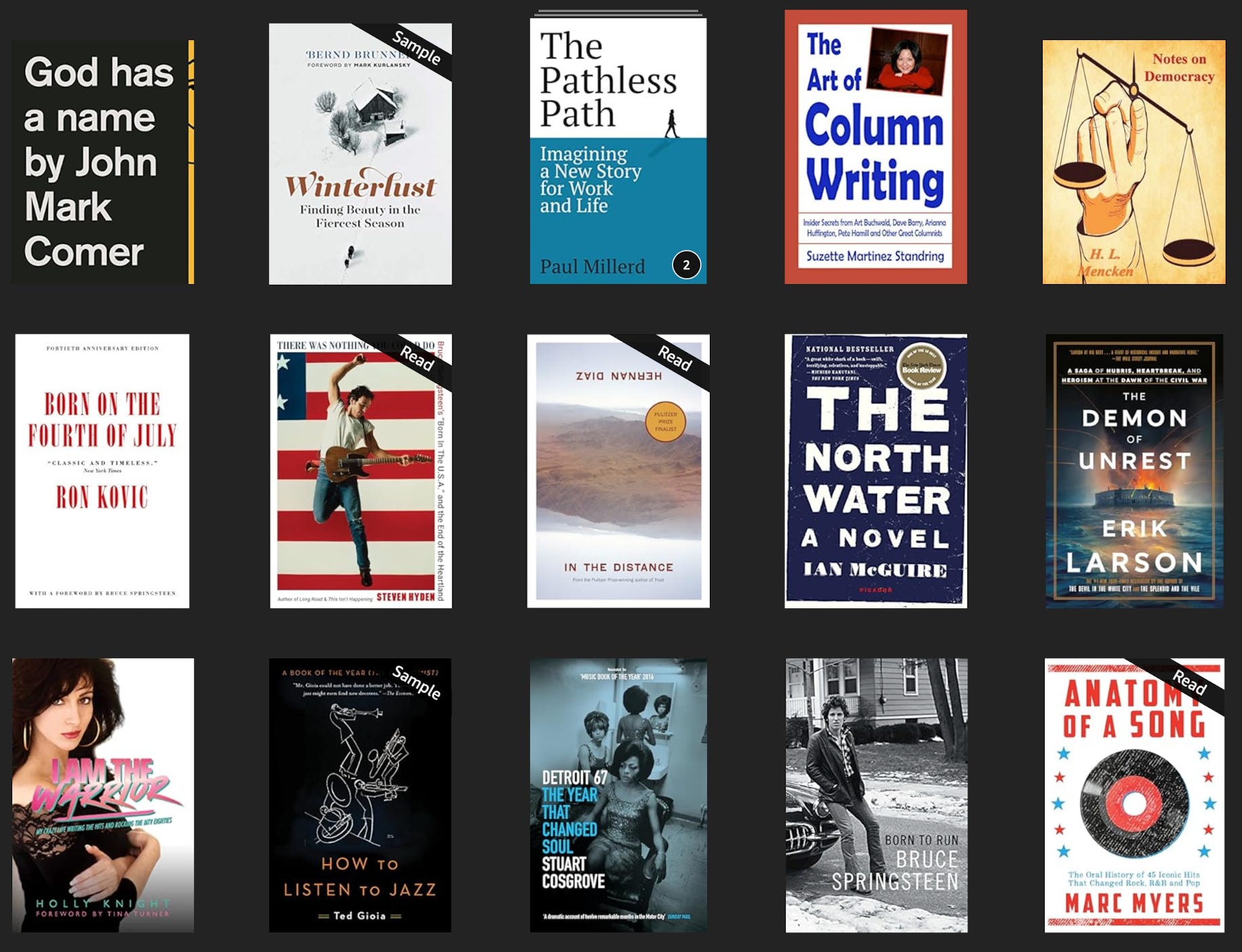
But the Kindle app is locked down. It’s hard to get all those highlights (over 26,000 of them, in my case) into a searchable or useful format. You either need a physical Kindle device to download them, or a subscription to a service like Readwise.
Otherwise, you can view them book by book in the Kindle app or in a browser.
Until AI, that is.
I opened the ChatGPT app on my Mac, and wrote a prompt saying I wanted a searchable database of all my Kindle highlights.
Codex (ChatGPT’s coding agent) asked me to log into Amazon. Then it opened four browser windows, and divided my books into four groups. Simultaneously, it opened and copied highlights from all my books.
Manually, that process would’ve taken weeks, if I’d ever had the patience to finish.3
Codex knocked it out in about ten minutes, giving me a CSV file containing each highlight and the book and author it came from. For garnish, it also provided an SQLite database4 and a search tool.
Cool. Now, what can I do with it?
The real power isn’t in being able to just search for funny Dave Barry lines, or baseball anecdotes, or some specific text.
The real power is in asking AI to identify patterns and connections across the highlights, and to quickly find all the relevant passages on a given topic area.
There is a lot to use here both as creative fuel, and to learn more about my own interests and how they intersect.
Queries can be made to find patterns across all the highlights, for example:
Which authors have I highlighted the most?
What kinds of ideas seem to resonate with me over and over?
Are there conflicting ideas I seem to return to?
What kind of life do my highlights collectively point toward?
What worldview emerges from these highlights?
Write a profile of the person who would have selected these 26,000 passages.
What subjects do I claim to care about that barely appear in my highlights?
Find highlights that complement my June 2026 journal entries.
Or on a more granular basis:
Find all my highlights around this idea: ____.
Find the best highlight to answer this question: ____.
I need a writing prompt. Find a surprising highlight I could build an essay around.
I love this.
It infuses individuality into my writing. These highlights represent what interested and surprised me going back to 2010, and that’s not replicable by AI.
Yes, AI can replace our reading. It can supplant our writing.
Or, we can use AI as a tool in our reading and writing to make it more useful, impactful, and poignant than ever.
I asked ChatGPT to find a Kindle Highlight to support the idea of AI as rocket fuel for the value of reading. It selected this, from Erik Larson’s The Demon of Unrest:
The search for these invariably becomes a journey full of unexpected surprises and revelations no matter how much a subject has been studied before—because every writer in every time brings to the field a unique lens through which to view the world, formed by his personal experiences and the character of his era.
AI doesn't have to pave over our unique lens. Instead, we can use AI to sharpen it.
Honestly, there’s comic books in there also. Call it 450 “books,” then. Comic books have reading value. I will write a pro-comics essay …
I understand this is sacrilege for many. There’s a whole other essay here.
I would not.
Whatever that is.